AI-Content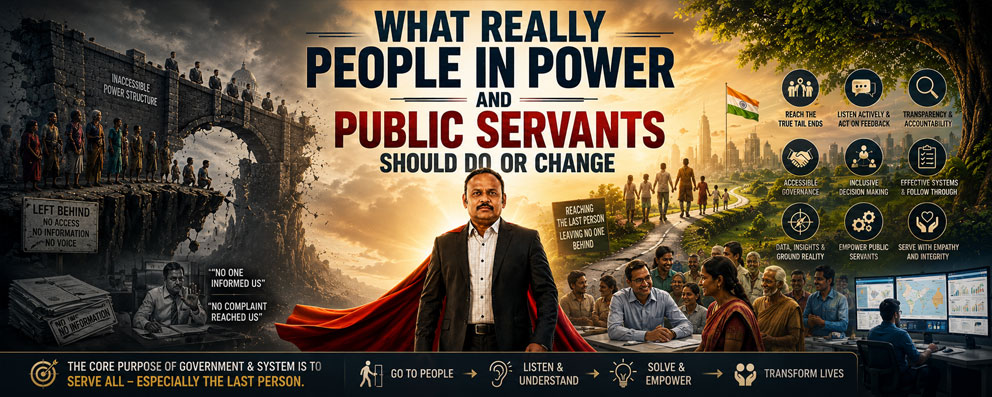
The Last Person Matters the Most
More than seven decades after Independence, India has made remarkable progress in infrastructure, technology, healthcare, education, digital governance, and economic growth. Yet one uncomfortable question continues to echo across the nation:
Have governance and public administration truly reached the last person in society?
Time and again, after an unfortunate incident or public grievance, we hear statements such as:
“We were not informed.”
“No complaint reached us.”
“This issue never came to our notice.”
If such statements continue to be repeated, it is not merely a communication gap—it is a signal that the governance ecosystem still has blind spots.
A government exists to serve every citizen, not only those who are visible, connected, influential, or capable of raising their voices. The greatest responsibility of governance is to ensure that the weakest, the poorest, the geographically isolated, the digitally excluded, and the socially marginalized receive equal attention.
Likewise, many citizens living at the grassroots still find it difficult to reach decision-makers. Between the citizen and the government often lie multiple administrative layers, procedural hurdles, lack of awareness, fear of authority, and communication barriers. These obstacles prevent genuine concerns from reaching those empowered to act.
Where Should Change Begin?
Real transformation does not always require more policies. It requires better connections between governance and people.
Public servants and elected representatives should increasingly focus on:
- Reaching people instead of waiting for people to reach them.
- Building proactive feedback systems instead of reactive complaint systems.
- Spending more time understanding ground realities through regular field visits.
- Using technology to identify silent problems before they become public crises.
- Measuring success by the quality of lives improved rather than the number of files processed.
Governance should become more accessible, transparent, accountable, and compassionate.
An Immediate Next Step
Every district, municipality, corporation, and village administration can adopt a simple but powerful approach:
“Last Mile Governance.”
This means periodically identifying communities that rarely approach government offices and proactively visiting them to understand their challenges.
Technology can further strengthen this effort through:
- Local digital grievance platforms.
- Ward-level citizen dashboards.
- AI-assisted issue prioritization.
- Community volunteers acting as information bridges.
- Real-time monitoring of unresolved public concerns.
The objective should not merely be responding faster—but ensuring that no genuine voice remains unheard.
Conclusion
The strength of a democracy is not measured by how efficiently it serves the powerful, but by how effectively it reaches the powerless.
When governments actively seek out the unheard, and when public servants become visible partners in people’s everyday lives, governance transforms from administration into true public service.
The real success of any government will not be judged by the tallest buildings or biggest projects—but by whether the last person in the last village feels that the government knows, cares, and responds.
Because the ultimate purpose of governance is simple:
Every citizen should be able to reach the system, and the system should be able to reach every citizen—especially those who need it the most.
Key Takeaway
Governance should never wait for problems to arrive. It should proactively reach people, understand their realities, and ensure that no citizen is left behind.
#Governance #PublicService #LastMileGovernance #GoodGovernance #CitizenFirst #AdministrativeReforms #PublicAdministration #DigitalGovernance #InclusiveDevelopment #Transparency #Accountability #GrassrootsGovernance #Policy #India #HelloTN #HelloTNPRO #PoliticalObservation