AI-Content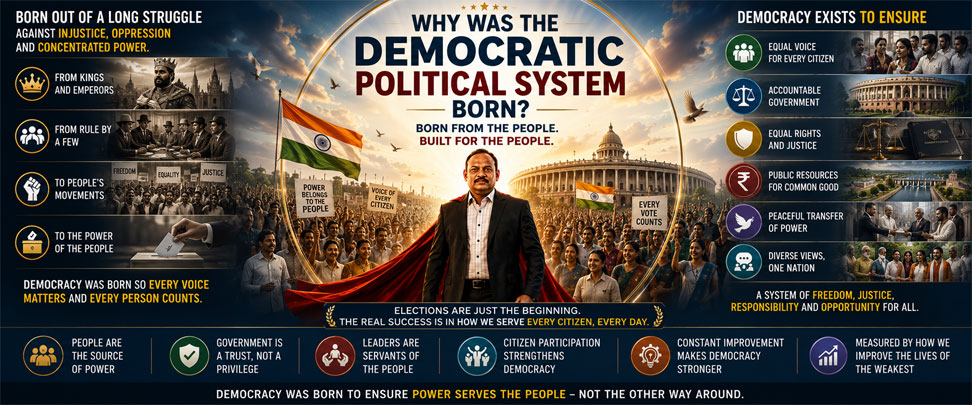
Understanding the Purpose Behind a Century-Old Democratic Idea
Democracy was not created simply as a method to elect governments.
It was born from humanity’s long struggle against concentrated power, injustice, and the absence of people’s voices. For centuries, many societies were ruled by kings, emperors, dictators, or small groups of elites, where ordinary citizens had little influence over decisions that shaped their lives.
Democracy emerged with a simple but powerful principle:
Power belongs to the people.
Governments are not owners of the nation—they are trustees, elected by citizens to govern on their behalf.
Why Does Democracy Exist?
The purpose of democracy extends far beyond elections. It exists to ensure that:
- Every citizen has an equal voice.
- Governments remain accountable to the people.
- Laws protect everyone equally.
- Public resources are used for the common good.
- Peaceful transfer of power replaces conflict and instability.
- Different opinions can coexist through dialogue rather than violence.
At its heart, democracy is a system designed to balance freedom, justice, and responsibility.
The Real Purpose of Political Power
Political power was never intended to become a privilege.
It was created as a responsibility.
Every elected representative, public servant, and institution exists to protect constitutional values, deliver essential services, uphold justice, and improve the quality of life for every citizen—especially those who are least able to help themselves.
The strength of a democracy is measured not by the influence of its most powerful citizens, but by the opportunities available to its weakest.
Has Democracy Reached Its Full Potential?
Over the years, democratic nations have achieved significant progress in education, healthcare, infrastructure, technology, and economic development.
At the same time, many societies continue to face challenges such as inequality, corruption, administrative delays, misinformation, and unequal access to public services.
These challenges do not mean democracy has failed. Rather, they remind us that democracy is an evolving system that requires constant improvement, active citizen participation, and accountable institutions.
What Should Democracy Become?
The next chapter of democracy should focus on becoming more responsive and inclusive.
Technology can help governments listen more effectively, deliver services faster, and make decisions based on evidence and citizen feedback. Public institutions can become more transparent, while citizens can participate more actively in shaping policies that affect their communities.
A healthy democracy is one in which government and citizens work together—not only during elections, but throughout the entire term of governance.
Conclusion
Democracy has endured because it is built on a timeless belief:
Every human being deserves dignity, opportunity, justice, and a voice in the decisions that affect their lives.
Elections are only the beginning.
The true success of democracy lies in what happens after the votes are counted—how governments listen, how institutions serve, and how every citizen experiences fairness, opportunity, and hope.
When democracy remembers its original purpose, political power becomes public service, governance becomes people-centric, and development reaches every corner of society.
Key Takeaway
Democracy was born to ensure that power serves the people—not the other way around. Its greatest success is measured by how well it protects rights, delivers justice, and improves the lives of every citizen.
#Democracy #PublicService #GoodGovernance #CitizenFirst #Constitution #Leadership #PeoplePower #DemocraticValues #Accountability #PoliticalSystem #Governance #InclusiveDevelopment #PublicAdministration #HelloTN #HelloTNPRO