AI-Content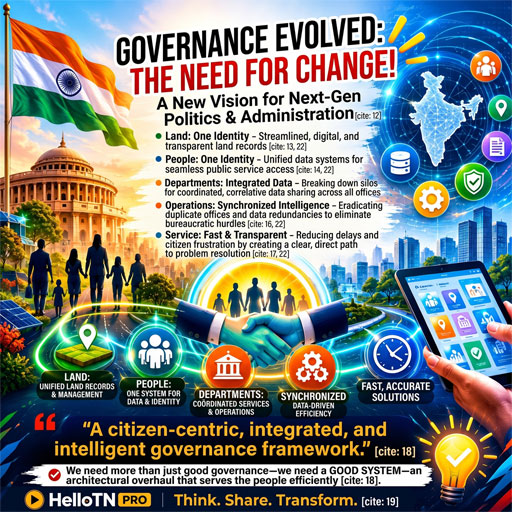
The Future of Governance Is Not Just About Who Governs, But How Governance Works
இதை தமிழில் படிக்க இங்கே கிளிக் செய்யவும்
Every election brings promises of political reforms, better leadership, and efficient administration. Governments change, policies evolve, and new welfare schemes emerge. Yet, millions of citizens continue to face the same frustrations—multiple offices, repeated document submissions, endless approvals, duplicate records, delayed services, and a lack of accountability.
The question is no longer “Who should govern?”
The question for the next generation is:
“How should governance function in a digitally connected society?”
India has made remarkable progress in digital infrastructure through Aadhaar, UPI, DigiLocker, GSTN, FASTag, CoWIN, and numerous state-level initiatives. However, these systems largely function as independent islands rather than as a unified ecosystem.
The next political revolution must be a Governance System Revolution.
The Existing Challenge
Every government department maintains its own records.
- Revenue Department maintains land records.
- Registration Department stores ownership details.
- Municipal bodies manage property taxes.
- Electricity boards have consumer databases.
- Water authorities maintain separate connections.
- Police have independent verification systems.
- Transport Department stores vehicle information.
- Welfare Departments maintain beneficiary databases.
Most of these databases overlap, yet they rarely communicate with each other.
The result is:
- Duplicate records
- Multiple verifications
- Repeated documentation
- Administrative delays
- Increased operational costs
- Frustrated citizens
Instead of serving people, citizens spend significant time navigating the system itself.
The Vision: One Nation, One Governance Data Ecosystem
Every citizen deserves a government that already knows what it needs to know.
Imagine a governance architecture where every public asset and stakeholder has a unique digital identity.
Unified Citizen Identity
A citizen should never have to submit the same information repeatedly.
A secure unified profile could connect:
- Identity
- Address history
- Family details
- Education
- Licenses
- Welfare eligibility
- Tax information
- Property ownership
while maintaining strict privacy and consent mechanisms.
Government departments should verify information from authenticated databases rather than asking citizens to produce the same documents multiple times.
Every Asset Needs a Digital Identity
Not only people.
Every public and private asset should have a standardized digital identification system.
Land
Every land parcel should have:
- Unique Land ID
- GPS coordinates
- Survey details
- Ownership history
- Encumbrance status
- Tax status
- Utility connections
accessible through authorized government systems.
No conflicting records.
No ambiguity.
No duplicate registrations.
Buildings
Each building should have:
- Building Identification Number
- Municipal approvals
- Structural details
- Occupancy certificates
- Utility connections
- Disaster safety compliance
linked under one digital profile.
Roads and Infrastructure
Every road, bridge, drainage system, public park, streetlight, water pipeline, and public asset should have a digital identity.
Maintenance history, contractor details, inspection reports, and repair schedules can become transparent and accountable.
Government Departments Must Share Data, Not Duplicate It
Today, one citizen’s address exists in dozens of government databases.
If the address changes:
the citizen updates Aadhaar,
then bank,
then driving license,
then voter ID,
then municipal records,
then electricity,
then water,
then tax records.
Why?
The government should update itself.
Connected Governance
Departments should function like connected APIs rather than isolated offices.
Instead of:
Citizen → Department A → Department B → Department C
the process should become:
Citizen → Single Digital Request → Unified Government Network
The departments internally coordinate and complete the process.
Remove Duplicate Government Offices
Many offices perform similar verification functions independently.
Verification teams.
Document validation teams.
Manual record rooms.
Physical archives.
Repeated inspections.
These consume enormous public resources.
Digital integration can eliminate unnecessary duplication while allowing officials to focus on governance rather than paperwork.
Governance Based on Location Intelligence
Every location should have a digital governance profile.
A village, ward, town, or city block should instantly provide:
- Population
- Schools
- Hospitals
- Roads
- Water connections
- Power infrastructure
- Businesses
- Government offices
- Welfare statistics
- Disaster vulnerability
- Development indicators
Planning becomes evidence-based rather than assumption-based.
Artificial Intelligence Can Improve Public Administration
AI should assist governance by:
- Predicting infrastructure failures
- Identifying fraud
- Detecting duplicate beneficiaries
- Optimizing public transport
- Managing traffic
- Forecasting water demand
- Prioritizing public grievances
- Allocating budgets based on actual needs
Government decisions become proactive instead of reactive.
A Citizen-Centric Service Model
People should never wonder:
- Which office should I visit?
- Which form should I fill?
- Which department is responsible?
- Who should approve my request?
A single citizen portal should automatically identify:
- the relevant department,
- responsible officer,
- service timeline,
- current status,
- escalation authority,
- and expected completion date.
Transparency builds trust.
Data Security Must Be the Foundation
Unified governance does not mean unrestricted access.
It requires:
- Role-based permissions
- Citizen consent
- End-to-end encryption
- Immutable audit trails
- Zero-trust architecture
- Privacy-first policies
- Independent oversight
Technology should empower citizens—not monitor them unnecessarily.
Measuring Government Performance Differently
Instead of evaluating governments solely by political achievements, future governance should be measured through:
- Average grievance resolution time
- Citizen satisfaction score
- Digital service accessibility
- Infrastructure uptime
- Department coordination efficiency
- Data accuracy
- Reduction in duplicate processes
- Time saved per citizen
- Cost saved per department
Efficiency itself becomes a public service.
The Next Generation Political Agenda
Political debates often focus on elections, alliances, welfare announcements, and legislation.
But the next generation deserves a broader conversation.
They deserve a governance model where:
- Data is unified.
- Departments collaborate.
- Public assets are digitally identified.
- Services are delivered seamlessly.
- Citizens are respected as stakeholders, not applicants.
- Government operates as one intelligent ecosystem instead of hundreds of disconnected offices.
This is not merely political reform.
It is Governance Transformation—a shift from bureaucracy to intelligent public service.
Conclusion
The future of governance will not be defined only by better leaders but by better systems.
A nation that digitally identifies its people, land, infrastructure, and public assets—and enables secure, coordinated data sharing across departments—can dramatically reduce delays, eliminate duplication, improve transparency, and enhance the quality of public services.
The next political movement should not simply ask for a change in government.
It should demand a change in the operating system of governance itself.
The future belongs to governments that are connected, intelligent, transparent, and citizen-first—not merely digital, but truly integrated.
#GovernanceReimagined #NextGenPolitics #DigitalGovernance #SmartAdministration #CitizenFirst #UnifiedData #PublicInnovation #HelloTNPRO